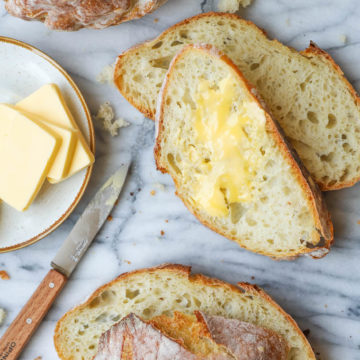
Easy No Knead Bread
An easy, no knead, fool-proof recipe for the most perfect crusty bread! So soft and fluffy inside. Just 4 ingredients, no special equipment!
Ingredients
- 3 ¼ cups all-purpose flour
- 2 teaspoons kosher salt
- ¾ teaspoon instant yeast
- 1 ½ cups warm water, 100-110 degrees F
Equipment
Instructions
- In a large bowl, combine flour, salt and yeast. Create a well in the center; add water.
- Using a wooden spoon or your hand, stir until a wet, sticky dough forms, about 1-2 minutes.
- Cover bowl tightly with plastic wrap and let stand at a warm place until doubled in size and surface is dotted with bubbles, about 6-8 hours.
- Working on a lightly floured sheet of parchment paper, fold dough over itself 3-4 times, turning after each fold; gently shape dough into a round.
- Cover with a clean dishtowel and let stand at room temperature until dough has doubled in size, about 1 hour.
- Preheat oven to 450 degrees F. Place a Dutch oven, covered, in the oven for at least 30 minutes.
- Remove Dutch oven from the oven; working carefully, place dough into the Dutch oven using the parchment paper as a sling.
- OPTIONAL: Using a sharp knife or bread lame, make a few shallow cuts on the top.
- Cover and place in the oven; remove the lid after 30 minutes. Continue baking until golden brown and completely cooked through, reaching an internal temperature of 210 degrees F, about 15 minutes more. Let cool 30 minutes on a wire rack.
- Serve warm.
Notes
- Use a Dutch oven. A heavy bottom pot with a lid, such as a Dutch oven, is key here for even heat distribution. This will help the bread rise appropriately and develop that favorited golden crusty exterior.
- Use warm water. The warm water will help activate the yeast to help the dough rise. If the water is too hot (120°F), the yeast can start to die, preventing the bread from rising.
- Make a wet shaggy dough. The dough should be sticky, wet and slightly lumpy to start. A dry dough will yield dense, tough bread. Always dust your hands and the parchment paper with some flour, making it easier to handle and shape the dough.
- Use parchment paper. Using parchment paper will help to transfer the dough into the hot preheated Dutch oven.
- Preheat the Dutch oven. Preheating beforehand will create steam, helping the dough open up and create a better rise with golden brown crisp ridges.
- Mix it up. Add leftover fresh herbs such as thyme, rosemary or sage, roasted garlic or freshly grated Parmesan cheese.
- Save leftovers for croutons. Any leftover bread should be cut into cubes for the best homemade croutons.
- Freeze as needed. Once cooled completely, cover the bread tightly with plastic wrap, then aluminum foil, freezing up to 3 months.