


Chinese Orange Chicken


This post may contain affiliate links. Please see our privacy policy for details.

Crispy, golden brown chicken bites tossed in a sweet and tangy orange glaze! A Chinese takeout favorite (made so much better) right at home.

Featured Comment
Why you’ll love this Chinese Orange Chicken recipe
- Takeout favorite. Now you can make your favorite Chinese takeout dish right at home, using better quality, fresh ingredients all around (no preservatives, no processed meat here!).
- Crispy coating. By using a combination of eggs and cornstarch, the chicken comes out unbelievably crispy and crunchy before getting tossed in an irresistible orange glaze. We’re talking perfectly crispy, sauced chicken bites here.
- Make-ahead friendly. The marinade serves both as a marinade and glaze (double whammy!), and the chicken can even be marinated ahead of time, cutting down prep time even further.
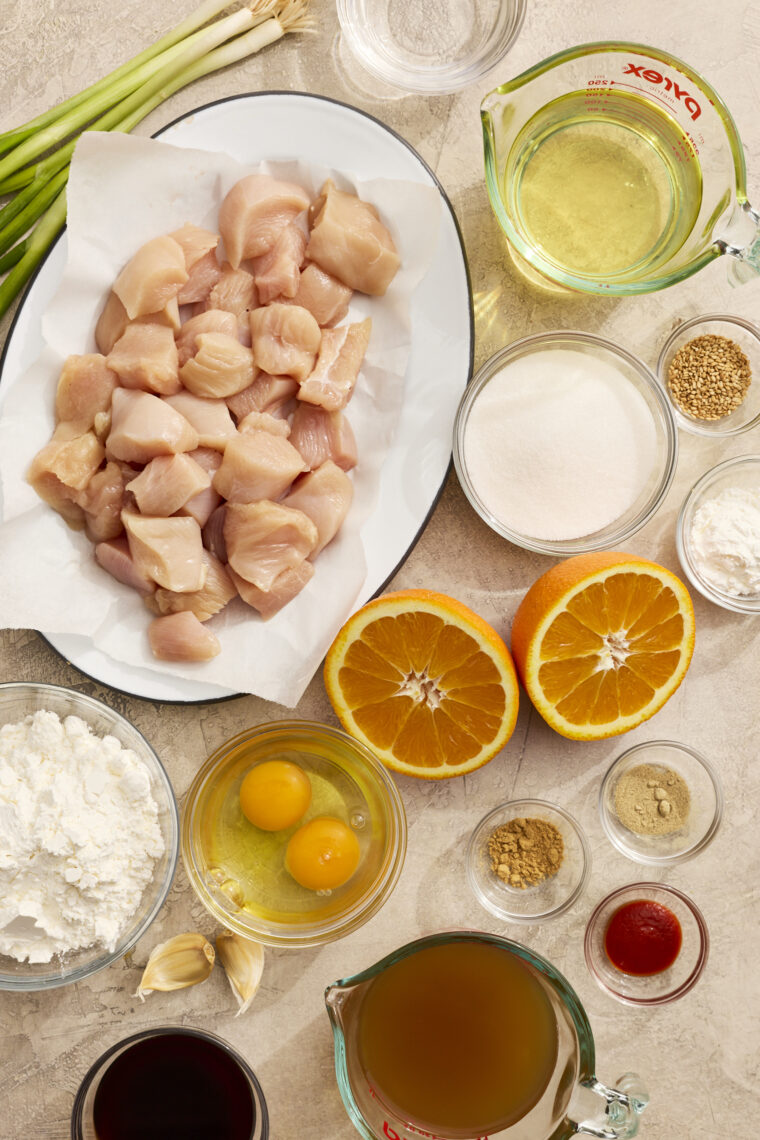
What is orange chicken?
Orange chicken is a popular Chinese-American takeout dish made with crispy chicken bites coated in cornstarch and deep fried, tossed in a sweet and savory orange sauce traditionally made with oranges, sugar, vinegar, and soy sauce (thickened by a cornstarch slurry). It is often times garnished with green onions and sesame seeds, and served alongside white rice.

General tso’s vs orange chicken
While both dishes include deep-fried battered chicken bites in Chinese-American cuisine, they each have distinct flavor profiles.
- General Tso’s Chicken: sweet and spicy sauce made with soy sauce, vinegar, sugar, and chili peppers (sauce is dark, red-brown color)
- Orange Chicken: much milder and sweeter than General Tso’s, made with oranges, sugar, vinegar, and soy sauce (sauce is light orange and much more syrupy)

How to make orange chicken
- Make the marinade. Firstly, whisk together the chicken broth, orange juice, sugar, vinegar, soy sauce, garlic, orange zest, Sriracha, ginger, and white pepper.
- Marinate. Then marinate the chicken for at least 30 minutes (never exceeding 12 hours), saving 1/3 of the marinade for the orange sauce.
- Make the orange sauce. Start with a cornstarch slurry (combining 2 tablespoons cornstarch with 2 tablespoons water). Simmer the reserved marinade, stirring in the cornstarch slurry until thickened and glossy.
- Coat the chicken. Dip each chicken piece into the beaten eggs before dredging in cornstarch, pressing to coat and shaking off any excess cornstarch.
- Cook the chicken. Cook the coated chicken in a large cast iron skillet until golden brown, working in batches to avoid an overcrowded pan. Transfer to a paper towel-lined plate to drain the excess oil.
- Toss or drizzle. Toss (or drizzle) the cooked chicken with the orange sauce, adding as little or as much sauce as desired. Pro tip: reserve some of the sauce to spoon over rice.
- Serve. Lastly, garnish with sesame seeds and green onions, serving over a bed of white rice alongside steamed broccoli.

Deep-frying tips to cook the chicken
Deep-frying chicken may seem a bit daunting, but with some attention to detail and these easy-to-follow tips, you’ll be making restaurant-quality (if not better!) orange chicken in no time.
- Use the right oil. Use vegetable or peanut oil, a neutral oil with a high smoke point.
- Maintain a consistent oil temperature. Use a clip-on deep-fry thermometer to monitor the oil closely, maintaining a steady temperature between 325 and 375°F.
- Work in small batches. Cook the chicken in small batches, about 5-6 pieces at a time.
- Let it rest on a wire rack. Let the chicken rest 5-10 minutes on a wire rack for even air circulation, achieving that perfect, shatteringly crispy coating.

what to serve with chinese orange chicken
Tools For This Recipe
Chinese Orange Chicken: Frequently Asked Questions
Both chicken breasts and thighs can be used here, but chicken thighs have more dark meat and a higher fat content which will yield juicier, more flavorful chicken.
Use a cornstarch slurry (cornstarch mixed with water) to achieve a syrup-like glaze, perfectly glossy, sticky, and sweet. Avoid bottled orange juice whenever possible, using fresh oranges for both the zest and juice to ensure a vibrant, bright citrus flavor for the sauce.
Yes! The chicken can be marinated 30 minutes to 4 hours in the fridge.
Marinate for 30 minutes for a quick flavor boost (and when you’re short on time). But 2-4 hours is the perfect sweet spot to tenderize and infuse the meat with flavor. But avoid marinating for longer than 12 hours or the chicken will be mealy and mushy.
It’s possible too much cornstarch was added. Loosen the sauce by adding a splash of water or freshly squeezed orange juice.
Add simple, restaurant-quality garnishes to elevate your dish such as orange zest, sesame seeds, and green onions.
Store the chicken and the orange sauce separately in airtight containers in the fridge for 2-3 days, reheating the chicken in the oven or air fryer at 350°F, and gently warming the sauce on the stovetop.

Chinese Orange Chicken
Ingredients
For the marinade
- 1 cup chicken broth
- 1 tablespoon orange zest
- ½ cup freshly squeezed orange juice
- ½ cup sugar
- ⅓ cup distilled white vinegar
- ¼ cup reduced sodium soy sauce
- 2 cloves garlic, minced
- 1 teaspoon Sriracha, or more, to taste
- ¼ teaspoon ground ginger
- ¼ teaspoon white pepper
- 1 ½ pounds boneless, skinless chicken breasts or thighs, cut into 1-inch chunks
For the cornstarch slurry
- 2 tablespoons cornstarch
- 2 tablespoons water
For the chicken
- 2 large eggs, beaten
- 1 cup cornstarch
- 2 cups vegetable oil
- ½ teaspoon sesame seeds
- 1 green onion, thinly sliced
Instructions
For the marinade
- In a large bowl, whisk together chicken broth, orange zest and juice, sugar, vinegar, soy sauce, garlic, Sriracha, ginger and white pepper.
- In a gallon size Ziploc bag or large bowl, combine chicken and 2/3 cup of the marinade; marinate for at least 30 minutes to 4 hours, turning the bag occasionally. Drain the chicken from the marinade, discarding the marinade.
For the cornstarch slurry
- In a small bowl, combine cornstarch and water.
For the orange sauce
- Heat remaining 1/3 marinade in a medium saucepan over medium heat. Bring to a boil; stir in cornstarch slurry. Cook, stirring frequently, until thickened and glossy, about 2-4 minutes; keep warm.
For the chicken
- Working one at a time, dip chicken into the eggs, then dredge in cornstarch, pressing to coat.
- Heat vegetable oil in a large cast iron skillet to 350°F. Working in batches, add chicken and cook until golden brown, about 3-4 minutes. Transfer to a paper towel-lined plate; discard excess oil.
- Serve chicken immediately, tossed or drizzled with the orange sauce, garnished with sesame seeds and green onion, if desired.
Equipment


Notes
- Cut the chicken into similar-sized pieces. Whether you’re using chicken breasts, thighs or tenderloins, dice the chicken into similar bite-sized pieces (about 1-inch chunks) for even, consistent cooking throughout.
- Use a cast iron skillet. A heavy bottomed skillet such as a cast iron skillet or Dutch oven has exceptional heat retention, ideal for even cooking and yielding perfectly crispy, evenly browned, juicy chicken.
- Use reduced sodium soy sauce. Reduced sodium has less sodium and less salt without compromising flavor.
- Freshly oranges go a long way. While bottled orange juice can work in a pinch, the orange zest and freshly squeezed orange juice are ideal here for its vibrant, stronger flavors.
- Avoid marinating for too long. The high acid content from the orange juice can break down the meat fibers if marinated for too long. Marinate the chicken for 2 to 4 hours.
- Check the temperature. Use a clip-on deep-fry thermometer to maintain a consistent oil temperature (about 325-375°F). If the oil goes past 375°F, the exterior will burn before the inside of the chicken is cooked, and if the oil is too cool, the chicken will absorb most of the oil, resulting in soggy, greasy chicken.
- Cook in batches. Cook the chicken in multiple batches as needed to avoid an overcrowded pan. An overcrowded pan will result in a drop in temperature, yielding soggy chicken bites instead.
- Mix cornstarch with water. Combining the cornstarch with water first (also known as a cornstarch slurry) will prevent lumps in the sauce, ensuring a smooth, glossy consistency and even thickening for the orange sauce.
- Sauce just before serving. This is crucial to avoiding soggy orange chicken. Toss the cooked chicken with the orange sauce right before serving for maximum crispness.
- Add garnishes. Make it restaurant-quality (especially when weekend company is over) by adding simple garnishes such as orange zest, sesame seeds and green onions.
- Prepare for leftovers. Store the chicken and the sauce separately if preparing for leftovers to preserve the crisp texture of the chicken.
Did you make this recipe?
Tag @damn_delicious on Instagram and hashtag it #damndelicious!


Made this tonight for dinner and it was so easy to make. So delicious that my picky 3 year old ate every bite.
this recipe was delicious and easily substituted with allergy friendly ingredients, which my family requires. I subbed coconut aminos for soy sauce and used a mix of gluten free flour and arrowroot powder for the coating and fried it in lard. I will definitely make it again and I can’t wait to try some of your other recipes!
Can you use brown sugar instead of white sugar in this recipe?
Kim, I recommend using brown sugar for optimal results.
Thank you for this recipe! Made it tonight for dinner. We LOVED it!! I’ll be making this again and again.
Like the comment above, I heed the idea of putting the chicken on a ziplock (after dipping on beaten eggs ), saves so much time. Well i tried this yesterday and even went back to the grocery store to buy the Sriracha, because it was a last minute decision to cook this recipe. My hubby said “this orange chicken is a winner”. Thanks to your wonderful recipe! More power!
Loved it! Delicious recipe. Cooked chicken longer and used another comment post which put cornstarch in ziplock bag to bread the chicken after dipping it in egg which I think saved some time and was probably easier. Turned out great. Served it with white rice and peas. Will make again! Thanks
Made this for dinner tonight, the flavor was amazing but I was disappointed with the texture..i fried the chicken and it was nice and crispy, as soon as I mixed in the sauce with chicken the coating began falling off on many pieces and biggest letdown is that is was not crispy! It was soft and almost soggy..what did I do wrong?
I’m thinking of trying readers suggestions of baking it in oven with the sauce, maybe that will be more crispy?
I will wait for your input I really want to make this again.
Your recipes look amazing, this is the first one I tried and can’t wait to try more, thank you!
Alina, the breading should not be falling off once the sauce has been added. I would make sure the breading is done thoroughly to avoid this. As for crispness, if served immediately, the chicken pieces should still be nice and crisp. Over time, they will get “soggy” in a sense as they are tossed with the orange sauce.
We did eat them right away after making. Regarding the coating, there was a nice layer on the chicken, I did coat it well, but I did not exactly “press” it in. Could this be the case?
Yes, absolutely. Without that step, the coating is barely hanging on, which as a result, comes apart when tossing it in the sauce.
Delicious! I used less oil and dipped chicken in mix of 2-3 tbsp cornstarch and 1 egg white. Fried in 2 tbsp oil. then added sauce and thickened in the pan. Really good thanks a lot for the recipe!
Hi Chung Ah! I want to try this simple recipe with amazing reviews. Any idea as to what I can sub for the egg coating? I was hoping to find someone with similar problem in reviews but no. One of my boys is allergic to eggs etc. but wants the try the orange chicken his brother raves about. I always thought they used flour – he is allergic to gluten too so happy to see you call for cornstarch. I know the coating is essential but can’t think of a good sub for eggs 🙁 I see you blog – any ideas based on experience? Gelatin maybe – that just came to mind lol but no experience
Kacey, unfortunately I’ve never tried a gelatin coating before and I’d hate to give you a substitution suggestion that may or may not work. I have read though that milk may work as a coating. Hope that helps!
Yum…I used legs & thighs, apple cider vinegar, fresh ginger. Browned the chicken, put it into pan, topped w/sauce and put into 400 degree oven until done…mmmmm…
This is a lovely recipe, thank you! I modded it using a half cup of marmalade instead of the half cup sugar, the half cup OJ, and the orange zest (I made the marmalade so I knew there were equal amounts sugar/OJ, and it had plenty of zest already in it). I also used fresh ginger instead of powdered. Since the sauce had large chunks of zest, after marinating, I strained it so the sauce would be nice and smooth. I served it with rice and some halved Brussels sprouts (browned in oil, then steamed until soft) that also got a nice dose of the orange sauce. Delicious!
I made this last night with chicken thighs b/c that’s what I had on had–I trimmed off the skin and took the meat off the bone then cubed my chicken into bite sized pieces.
I would say the frying time for the chicken, b/c I used thighs, is the most difficult. Its just hard to know if your chicken is cooked all the way through; eventually I settled on 4 minutes for each batch.
The sauce–I think it really makes the dish! But really mince your garlic finely or you will end up with raw pieces of garlic on your finished product. There needs to be more sauce overall, I would probably try to tweak the recipe in the future to make more sauce to pour over my cooked chicken, or reduce the 2/3 of it for the marinade as it was plenty and then some in the ziploc bag.
Great recipe! Thank you!
I’m so glad you gave this a try! One suggestion – you can always press your garlic in order to avoid having huge chunks of garlic pieces in your finished dish.
What kind of vinegar are you using ? Thank you 🙂
Brit, I used distilled white vinegar.
I followed this recipe almost to the letter. I did reduce the vinegar by half as I’m not too fond of the vinegar taste, also reduced the amount of frying oil so that the battered chicken pieces were only half submerged in oil. I also toasted the sesame seeds a little to create an aroma. The final dish came out perfectly! The taste has a bit of everything – tangy, sweet, and spicy. Even better than the restaurant version, just as the author claimed! Thank you for posting this recipe, please keep them coming! 🙂
Thanks so much for the recipe!!! I loved it. I’m trying my leftover marinating chicken in the deep fryer instead of stove top tonight. I can’t wait to try variations of this recipe, I’m doing lime & chili peppers next! Thanks for the inspiration, all your recipes look great!!
Hi,
Just discovered your website and this is the first dish I tried. We had it for dinner tonight, and everyone loved it. It’s a keeper!
Just one small point. You say to fry the chicken pieces for 1 – 2 minutes. My oil (I used peanut oil) was hot, yet after 2 minutes of cooking the chicken was still quite raw. I cut them in 1 inch pieces as per your instructions. I found it took much longer to cook the chicken, about 6 – 7 minutes. I just checked the website for the recipe you adapted this from, and see that the recommended cooking time is 7 minutes. I’m surprised no one else has remarked on this in your comments. I hope they haven’t all been eating undercooked chicken as this is very dangerous! After 6 – 7 minutes my chicken was perfectly cooked. Crisp on the outside, and juicy (but cooked) on the inside. The sauce was delicious! I used cider vinegar which I think adds more depth to the flavour. Thank you for this delicious recipes. Tomorrow I will be making your sriracha salmon.
Anne, this really depends on several factors, such as how thick or thin your chicken pieces are and how hot your oil is. Your oil should be at about 300-350 degrees F. With that kind of heat, cooking the chicken for 6-7 minutes would result in completely overcooking the chicken and making it incredibly rubbery.
Hi Chung-Ah,
Thank you for replying. My oil was heated to 350 degrees and my chicken breast was cut in 1 inch cubes as per your instructions. I marinated the chicken for one hour. I am wondering why the website you adapted this recipe from says to cook it for 7 minutes and you say 1 – 2 minutes. My chicken, after 6 minutes was still juicy and tender, and the battery was crispy. After cutting into a piece after two minutes of cooking, it was visibly pink and undercooked in the centre. I don’t mean to criticize but I am very concerned that some novice cooks will not check the chicken for doneness, toss it in the sauce and eat it, thus risking getting sick. Undercooked chicken is very dangerous.
Anne, I understand and appreciate your concerns but as you can see from the comments here, a lot of people have tried my tested recipe, followed my instructions, and have had amazing results. But as mentioned before, if your oil is not hot enough or if your chicken pieces are not entirely all that small, people will have to make adjustments accordingly.
This recipe was SUPER and we were fighting over the left overs today for lunch. One we can’t wait to make again! I did want to share that I too had a longer cooking time with my chicken pieces – which were all to your specs, too (size, marinade time…etc). Ours maybe even longer than 7 minutes with the oil at the right temp. Even with that, they were juicy and crsipy…etc. Honestly, I thought nothing of it last night – just blamed it on my pan not conducting evenly or well enough:)
Ironically, I also used Peanut Oil instead of Vegetable Oil….perhaps Peanut Oil has a unique impact on the frying time? I am more curious than anything…it would not prevent me from making this again, either way — IT WAS THAT GOOD!!!
I made this today. The flavor was great. My question is how do you fry the chicken and have it turn out smooth and not lumpy? I don’t fry things often, so I guess I just need some good pointers.
Kristy, a little bit of “lumpiness” is actually normal!
Wow made this for dinner tonight, used a chilli and garlic sauce as no Sriracha that I could easily find in New Zealand, but was delicious! Will definitely be making this again, thanks for the recipe 🙂
I made this for the first time and my family flipped for it! I used red pepper flakes because I didn’t have sriracha, and it gave it some heat. Cut up and marinated the chicken the night before, so when I got home from work, I just breaded and cooked the chicken, made a veggie and rice and finished the sauce! It was fantastic!
Can you use olive oil instead of vegetable oil? Great recipe by the way! Can’t wait to try it out soon!
Unfortunately, due to the difference in smoking points, olive oil is not an appropriate substitute.